“Fascia Stretch Therapy™ (FST) is a gentle, pain-free, and highly effective method of improving mobility, flexibility, and stability by targeting the body's joints and fascia — the connective tissue system that supports and influences every movement.” –stretchtowin.com
If your first reaction was, ‘Okay…but isn't that just stretching?’ you're probably not alone.
Fascial Stretch Therapy is much more than having someone help you touch your toes. It's a practitioner-assisted approach that uses gentle movement and stretching in multiple directions while you relax on a treatment table.
Most of us learned stretching by thinking about the body in individual pieces: this stretch is for your shoulders, this one is for your hamstrings, this one is for your calves.
FST looks at the body a little differently.
Rather than simply finding something that feels tight and stretching it, the practitioner looks at how you're moving and why that movement may be restricted. Maybe your hip moves easily in one direction but not another. Maybe changing the position of your pelvis completely changes the movement. Maybe the place where you feel tight isn't the only area influencing what's happening.
What the practitioner finds helps guide how your body is moved and stretched, making FST another tool in a manual therapist's toolbox for assessing and treating movement.
FST isn't about seeing how far we can stretch you. It's about looking at how your body moves and using assisted movement and stretching to help it move better.

What Is Fascia?
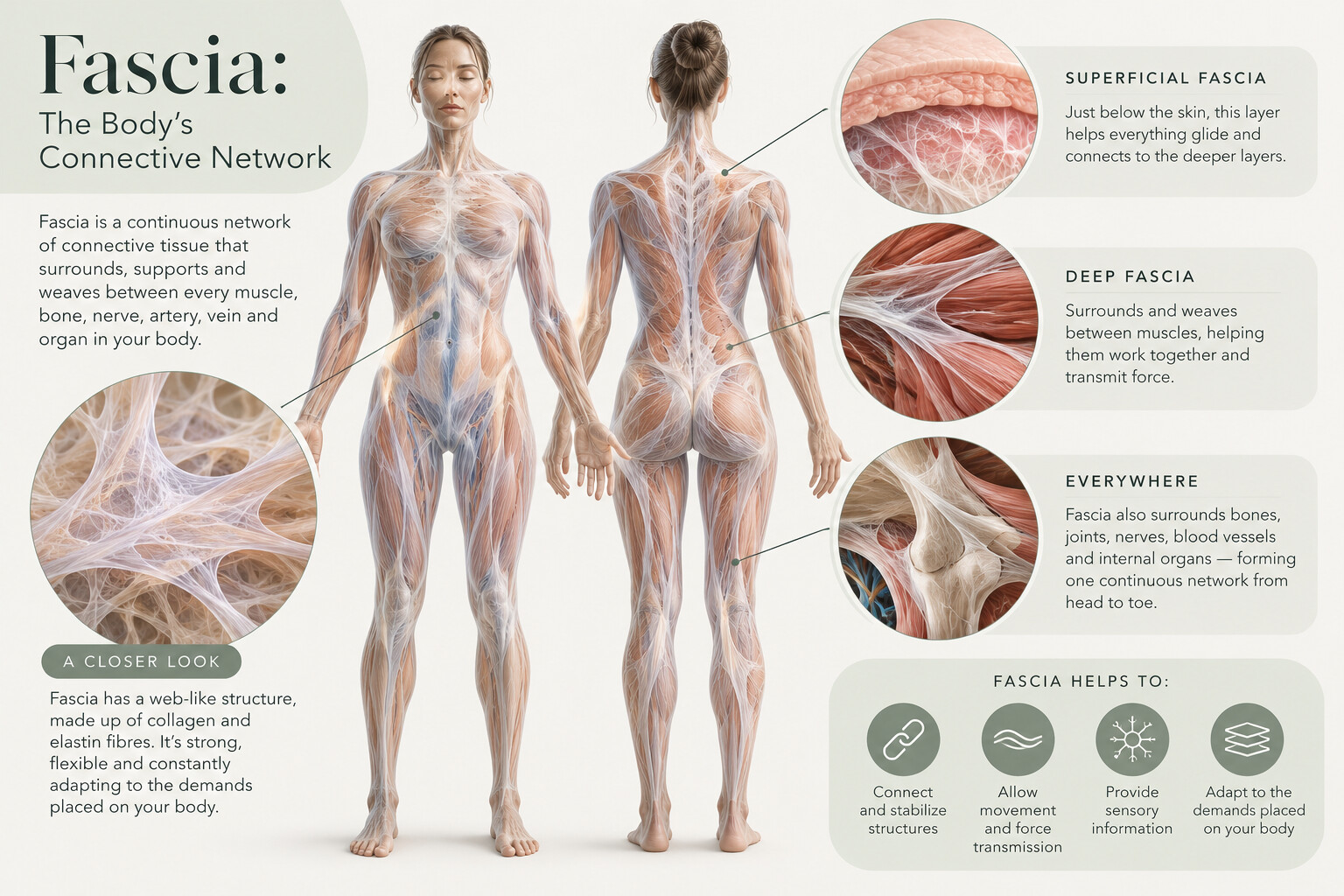
“Fascia is a specialized system of the body that has an appearance similar to a spider's web or a sweater. Fascia is very densely woven, covering and interpenetrating every muscle, bone, nerve, artery and vein, as well as, all of our internal organs including the heart, lungs, brain and spinal cord. The most interesting aspect of the fascial system is that it is not just a system of separate coverings. It is actually one continuous structure that exists from head to toe without interruption. In this way you can begin to see that each part of the entire body is connected to every other part by the fascia, like the yarn in a sweater.”
— John F. Barnes
One of my favourite educators in massage therapy, Tom Myers, describes it even more simply: “Fascia is the biological fabric that holds us together, the connective tissue network.”
And that's really the important part: fascia is everywhere.
Think of it a little like a pair of nylons — except instead of wrapping around your legs, this connective tissue network surrounds, supports and weaves between structures throughout your entire body. It helps muscles move alongside one another, supports and organizes structures, and quite literally helps hold all of our individual parts together.
It's also living, sensory tissue, containing nerve endings that provide information about movement, position and what's happening within your tissues.
But just like every other tissue in the body, fascia can be affected by what happens to us.
Injury, surgery and scar tissue can change how tissues move. Repetitive movement can continually load the same areas, while long periods in one position or simply not moving enough can reduce the variety of movement those tissues experience. Age and changes in activity can affect them too.
Sometimes that restriction is local. A surgical scar, for example, may change how the skin, fascia and other tissues move around that specific area.
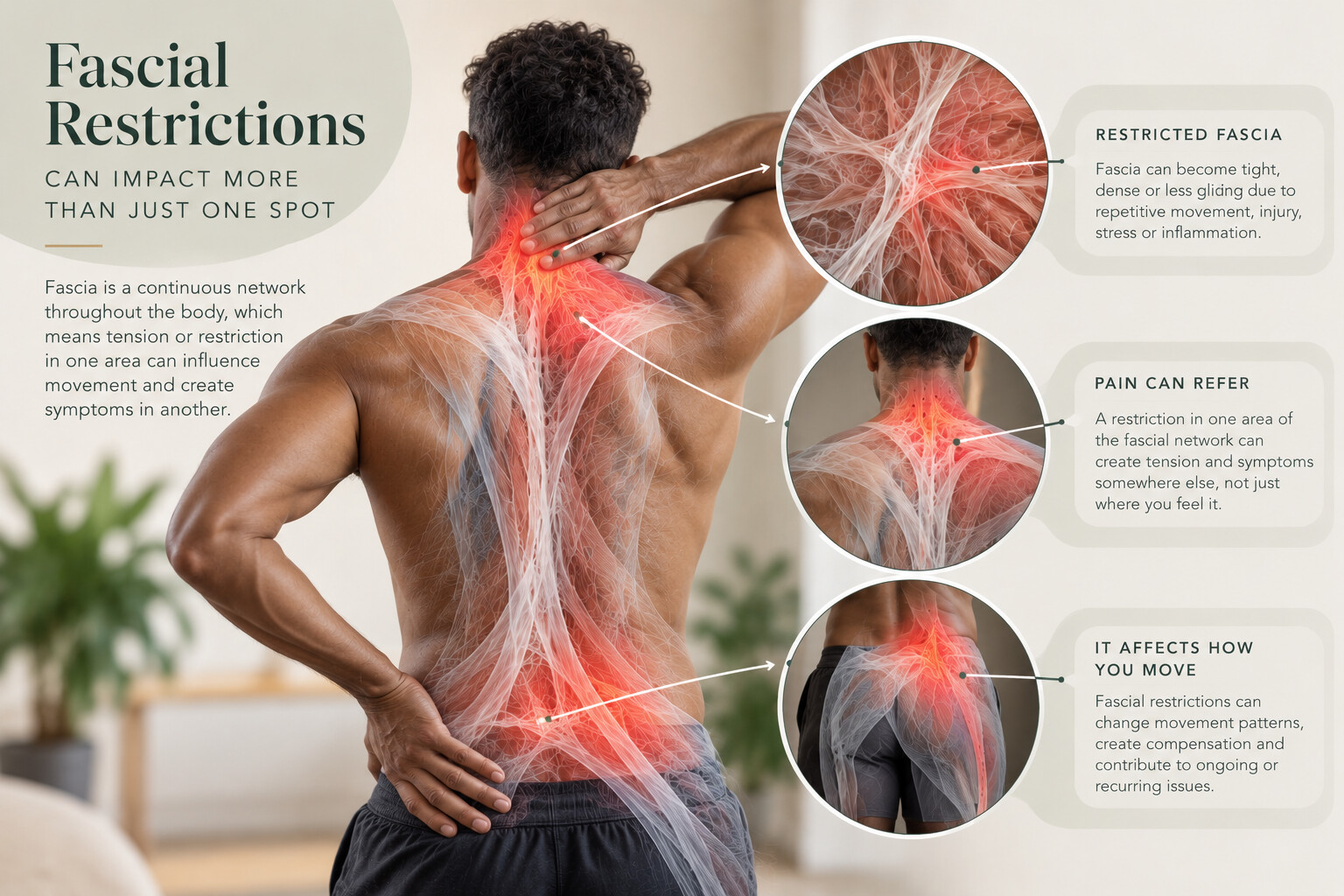
But because fascia forms a continuous network — and our bodies don't move as a collection of independent parts — a change in one area can also influence how we move elsewhere.
And then we adapt.
Our bodies are incredibly good at finding another way to accomplish a movement. We shift, rotate, brace, shorten our stride or rely more heavily on another area to get the job done. That adaptation can be useful, but over time those compensations can create their own patterns of restriction and altered movement.
That's why a fascial restriction doesn't always feel like one obvious “tight spot.” What starts as a local change can sometimes influence how the body moves as a whole.
FST Isn't Just “Better” Stretching
With a name like Fascial Stretch Therapy, it's pretty easy to assume that FST is essentially a more advanced version of the stretching you already do at home.
But that's not really the point.
FST isn't better stretching — it's a therapy that uses stretch.
When you stretch on your own, the goal is usually pretty straightforward: something feels tight, so you stretch it.
In FST, the stretch itself is only part of what's happening. The practitioner uses movement and stretch to assess where restrictions appear and how they change with different positions, angles and directions. What your body does helps guide what happens next.
The stretch then becomes part of the treatment. Using gentle, rhythmic movements through different ranges and planes of motion, the practitioner can adjust the position, direction and amount of stretch based on how your body responds.
And this is where everything we just talked about with fascia becomes important. The place that feels tight isn't always the whole story. Sometimes that's where the restriction is. Sometimes it's responding to something happening elsewhere. And sometimes several pieces are contributing to the way you're moving.
The stretch is the tool. Improving how your body moves is the bigger picture.
Who Might Benefit From FST?
You don't have to be an athlete — or even particularly active — to have a reason to work on how your body moves.
Maybe your neck hurts when you turn to shoulder-check. Your low back aches when you stand after sitting too long. Your shoulder hurts when you reach overhead, or your hip feels painful and restricted when you try to put on your shoes.
Maybe pain isn't the biggest issue. Your hamstrings always feel tight no matter how often you stretch them. One side moves completely differently than the other. You've lost some of the mobility you used to have, or something hasn't moved quite the same since an old injury or surgery.
Or maybe it's that frustrating problem that just keeps coming back.
Treatment helps. You do your home care. Things improve — and a few weeks later, you're dealing with it again. Or you've made great progress but seem to have hit a plateau where things just aren't changing anymore.
That doesn't mean what you've already been doing hasn't worked. Sometimes it simply means it's worth looking at the problem through a different lens.
Because FST looks beyond the spot that hurts or feels tight, it gives your practitioner another way to explore the bigger movement pattern. Is there a restriction that hasn't been addressed? Has your body adapted around an old injury? Is one area moving differently and asking another area to continually pick up the slack?
FST isn't a magic answer to every stubborn problem. But when progress has plateaued or the same issue keeps returning, it can be another tool to help explore whether there's another piece of the puzzle.
And sometimes the goal is simpler: move more comfortably, maintain your mobility as you age, get back to an activity you love, or improve the movement you need for your sport.
You don't need to know what's causing the problem before you come in. You just need to know that something isn't moving or feeling the way you'd like it to.
Where Does FST Fit Into Your Care?
FST doesn't have to be an either/or decision.
It can be used on its own, incorporated into a manual therapy treatment, or become one part of a broader treatment plan alongside the other care you're already receiving.
That's especially important when we're dealing with problems that aren't simple. Pain, restricted movement and recurring issues don't always have one cause — and they don't always respond to one approach. Sometimes what we learn through movement assessment or FST can help inform the work we're already doing. Other times, it may point toward another practitioner or modality that could add a different piece to your care.
That's the benefit of collaborative treatment: we don't have to make one tool do every job.
FST is simply another way we can look at movement, work with the body and help you toward whatever your goal happens to be.
If you're wondering whether FST could be useful as part of your treatment, talk to your Kollectiv practitioner. We can look at what you're experiencing, what you've already tried and where you're trying to get to — and figure out together whether FST belongs in that plan.