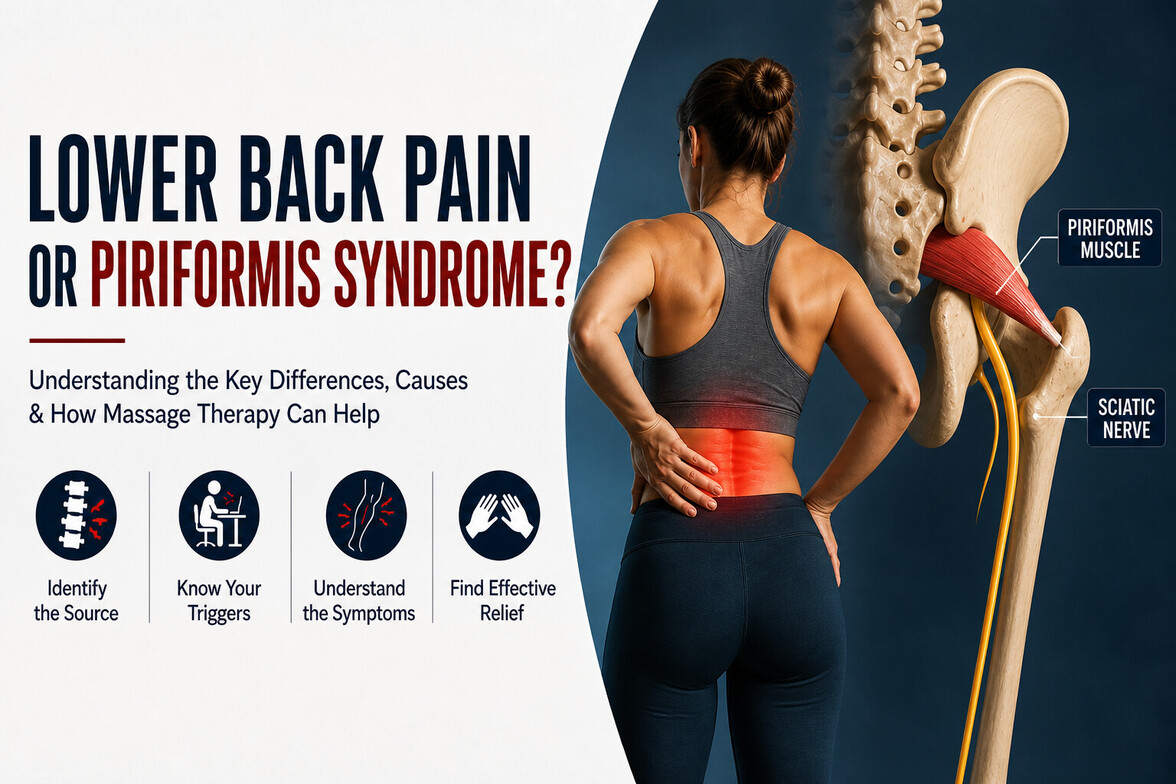
Many patients come into the clinic with back aches and tension. In this case were going to look at the potential causes of lower back tension and pain.
There are two main sources of a similar issue; actual lower back pain stems from spinal issues, like a herniated disc, or arthritis, affecting nerves at the spine. While piriformis syndrome is a neuromuscular disorder caused by the piriformis muscle deep in the centre of the hip compressing the sciatic nerve.
Patients with actual lower back pain stemming from the spine don’t typically get total relief from massage and stretching unfortunately, as it is more complicated a problem than just a muscular issue. Key differences to figuring out what the real source is include location; is the pain right in your back, or in your hip? What kinds of things trigger your pain; bending or sitting? Does your pain radiate up or down at all?
It can be tricky to figure it out, as pain symptoms can stem from the same areas but here are some examples to make it easier to understand:
- Pain Location: Lower back pain often starts in the lumbar spine, while piriformis syndrome primarily causes deep, intense pain in the hip.
- Piriformis issues can feel like there is a “belt” of tension along the top of the hip.
- Trigger Activities: Piriformis syndrome pain significantly worsens with prolonged sitting, climbing stairs, or walking, while general back pain is often triggered by bending or lifting.
- These symptoms happen due to a “tug of war” happening between the piriformis muscle and the lumbar spine muscles, such as quadratic lumborum (QL), pulling against each other. Piriformis is one of the few muscles that has twisted fibres instead of straight. When is becomes tight it will pull the tailbone and spine down and in, and the QL will pull up and out.
- Radiation Pattern: Both can cause sciatic nerve pain down the leg, but piriformis syndrome rarely radiates above the hip or into the lower back, unlike lumbar spinal issues.
- Physical Tests: FADIR (Flexion, Adduction, Internal Rotation) test is often positive for piriformis syndrome, causing hip pain.
Alison King
Contact Me